Synastry
Compare two natal charts with Moshier ephemeris and read the aspects between both people's planets.
Quick answer
Aurapure's synastry compares two natal charts computed with Moshier ephemeris and measures the aspects between one person's planets and the other's (conjunctions, trines, sextiles, squares, oppositions, quincunxes), using the same orbs as the natal chart. Enter both birth dates, times, and places: calculation and the aspect tally are free.
Enter two people's birth details to see the aspects between the charts.
How to use synastry
- 1Enter the first person's details. Birth date, time, and place: used to compute the first natal chart.
- 2Enter the second person's details. Same fields for the other person. Time helps for Moon and Ascendant; without it we use local noon.
- 3Run the comparison. Aurapure computes both charts and measures cross-aspects between the two people's planets.
- 4Read the balance. The tally of harmonious and challenging aspects is a number, not a verdict: the reading stays symbolic and contextual.
What is synastry?
It is the astrological comparison of two natal charts: the aspects one person's planets make to the other's are observed. In symbolic tradition it reads relationship dynamics — emotional, communicative, creative — not a «couple destiny».
How do you interpret it?
Look at cross-aspects (conjunctions, trines, squares…) and the balance between harmonious and more demanding ones. A single aspect does not define a relationship: the full picture and real context matter.
Do both birth times matter?
An exact time improves Moon, Ascendant, and houses. Without time, aspects between slow planets (Saturn, Jupiter, etc.) remain reliable; those involving Moon and angles are approximate.
What is it for?
To explore resonances and tensions between two people with a shared symbolic language. It does not replace dialogue and awareness: it offers reflection, not forecasts.
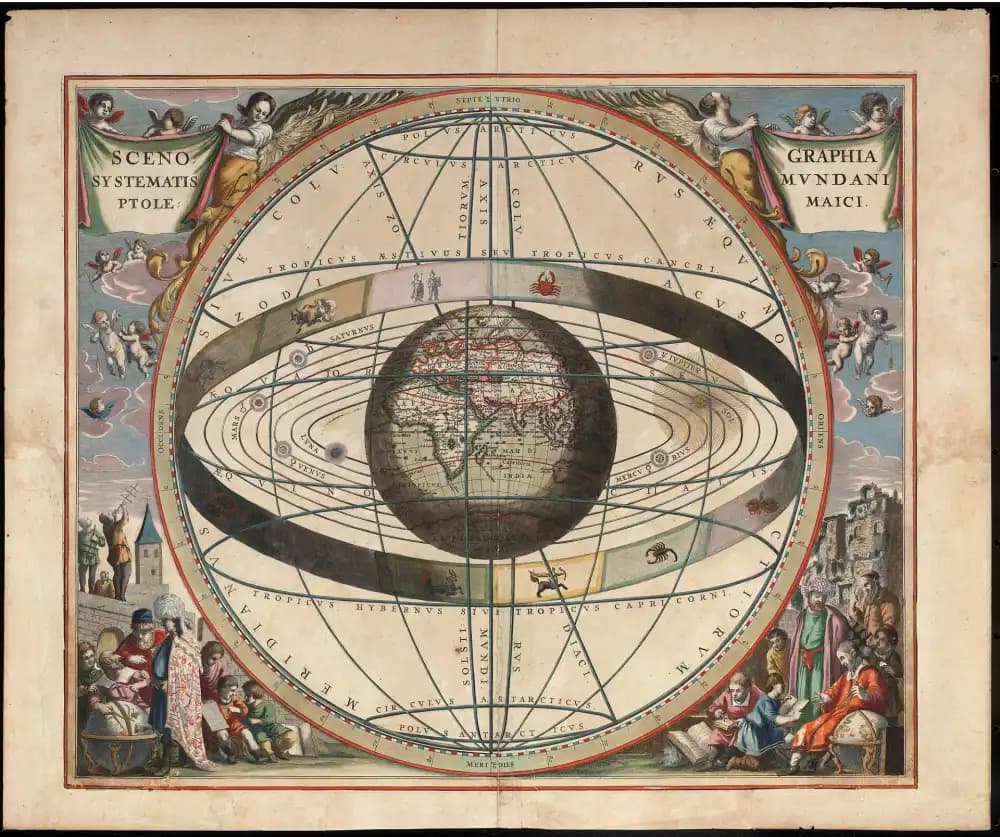
The zodiac in Cellarius's atlas
Andreas Cellarius, Harmonia Macrocosmica (Amsterdam, 1660), plate II: the band of the zodiac around the Earth in the Ptolemaic system.
Public domain, Wikimedia Commons

Frequently asked questions
- What is synastry?
- It's the comparison of two natal charts: the aspects one person's planets make to the other's are measured to read a relationship's dynamics.
- Do both birth times matter?
- It helps a lot: without a time the Moon and Ascendant are approximate (we use local noon). Aspects between slower planets stay reliable even without a time.
- How do you read compatibility?
- We tally harmonious aspects (trine, sextile) and challenging ones (square, opposition). The balance is a number, not a verdict: no couple reduces to a score.
- Is it free?
- Yes for the calculation and aspect tally. In-depth interpretive readings are in progress.