In short
The I Ching, the Book of Changes, is one of the oldest texts in the Chinese tradition, used as an oracle for millennia. It rests on 64 hexagrams — figures of six yin (broken) or yang (solid) lines, each describing an archetypal situation. It does not predict a fixed future: it offers a symbolic map of the present moment and the forces in motion, to reflect on a question with more clarity.
The I Ching, or Book of Changes, is one of the oldest texts in the Chinese tradition. It is not about fixed prediction: it offers a symbolic map of the present and the forces in motion. Its central idea is change itself — nothing stays still, and every situation already carries the seed of its transformation.
Yin, yang and the six lines
At the root of the I Ching are two complementary forces: yin (receptive, broken line) and yang (creative, solid line). Six stacked lines form a hexagram, read from bottom to top. The combination of yin and yang lines generates 64 possible figures: not a moral judgement, but a snapshot of the quality of a moment.
The eight trigrams
Every hexagram is born from two trigrams, the building blocks of the system. The eight trigrams stand for natural forces: Heaven (creative force), Earth (receptivity), Thunder (movement), Water (danger and depth), Mountain (stillness), Wind/Wood (gradual penetration), Fire (clarity), and Lake (joy). The trigram above and below give the hexagram its meaning.
The 64 hexagrams
The 64 hexagrams span the full range of human situations: the beginning, waiting, conflict, peace, return, stagnation, revolution. Each has a name, an image, and a judgement that guide reflection. They describe not a destiny but a context: how the moment presents itself and which attitude moves through it best.
Moving lines and the transformed hexagram
When you cast the oracle, some lines can be 'moving': points of maximum tension about to flip into their opposite. Moving lines transform the initial hexagram into a second one, showing the direction of change — where the situation starts and what it tends toward. This is where the I Ching becomes dynamic rather than static.
Why consult it today
Many people use the I Ching to clarify decisions, relationships, and work. An honest question and the casting ritual help you step out of autopilot and see the context with more clarity. It does not replace judgement: it accompanies it, offering a symbolic language to view a situation from a new angle.
How to use it on Aurapure
Our tool uses the authentic three-coin method, calculates moving lines and the transformed hexagram, and returns a readable on-page interpretation — with original prose, marked as a draft under review, and no invented citations.
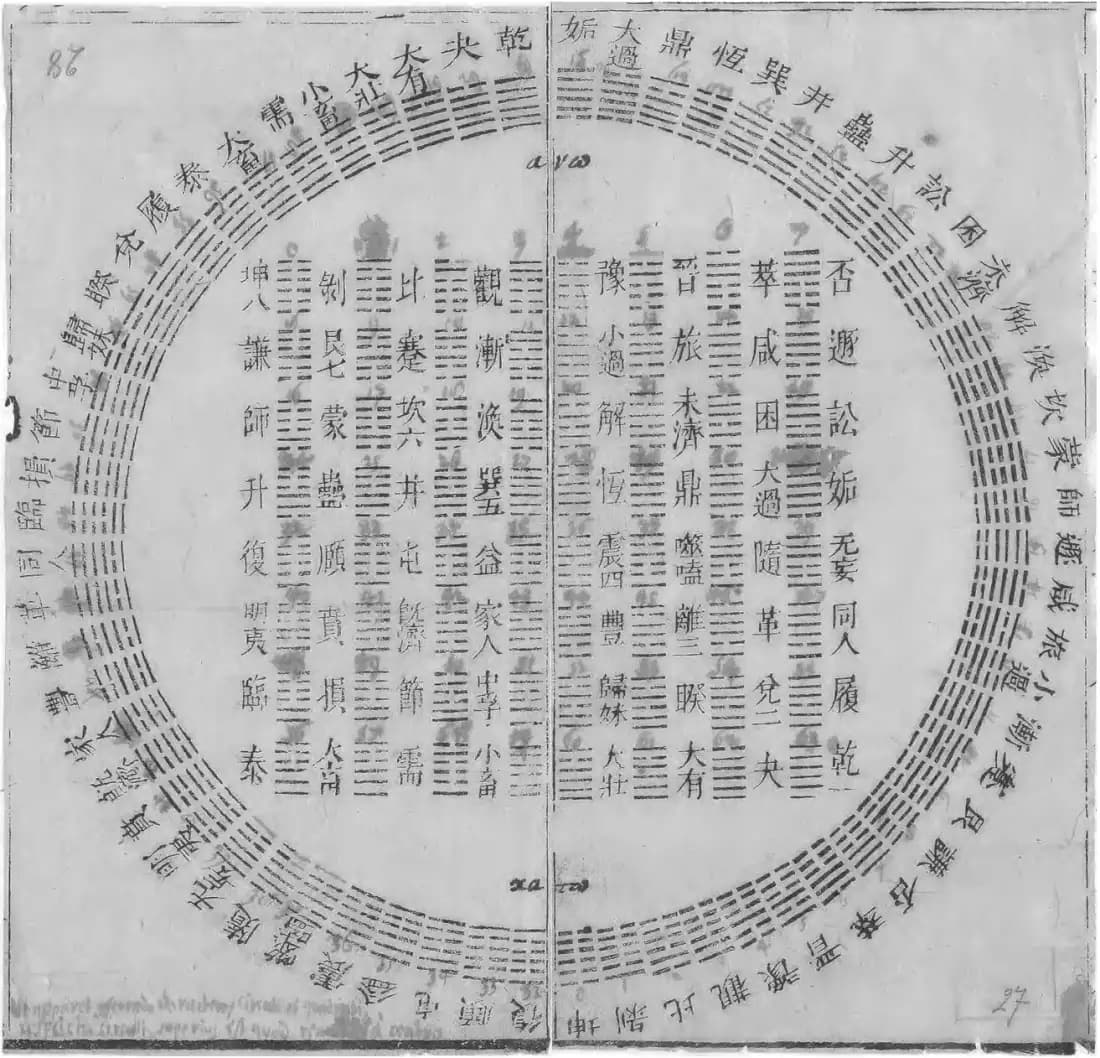
The 64 hexagrams Bouvet sent to Leibniz
Diagram of the 64 hexagrams in Shao Yong's order, sent by Joachim Bouvet to Gottfried Wilhelm Leibniz in 1701.
Public domain, Wikimedia Commons

Frequently asked questions
- Does the I Ching predict the future?
- Not in a deterministic sense: it describes tendencies and qualities of the moment. The answer invites awareness and responsibility.
- How many hexagrams does the I Ching have?
- Sixty-four, obtained by combining the eight trigrams with each other (8 × 8). Each hexagram is made of six yin or yang lines.
- What are moving lines?
- They are the lines at the peak of their tension, which turn into their opposite and generate a second hexagram: they indicate the direction of change in the situation.
- Do I need prior study?
- No to begin: you can consult the oracle immediately. Exploring the 64 hexagrams deepens understanding over time.
Next step
Consult the I Ching oracle